
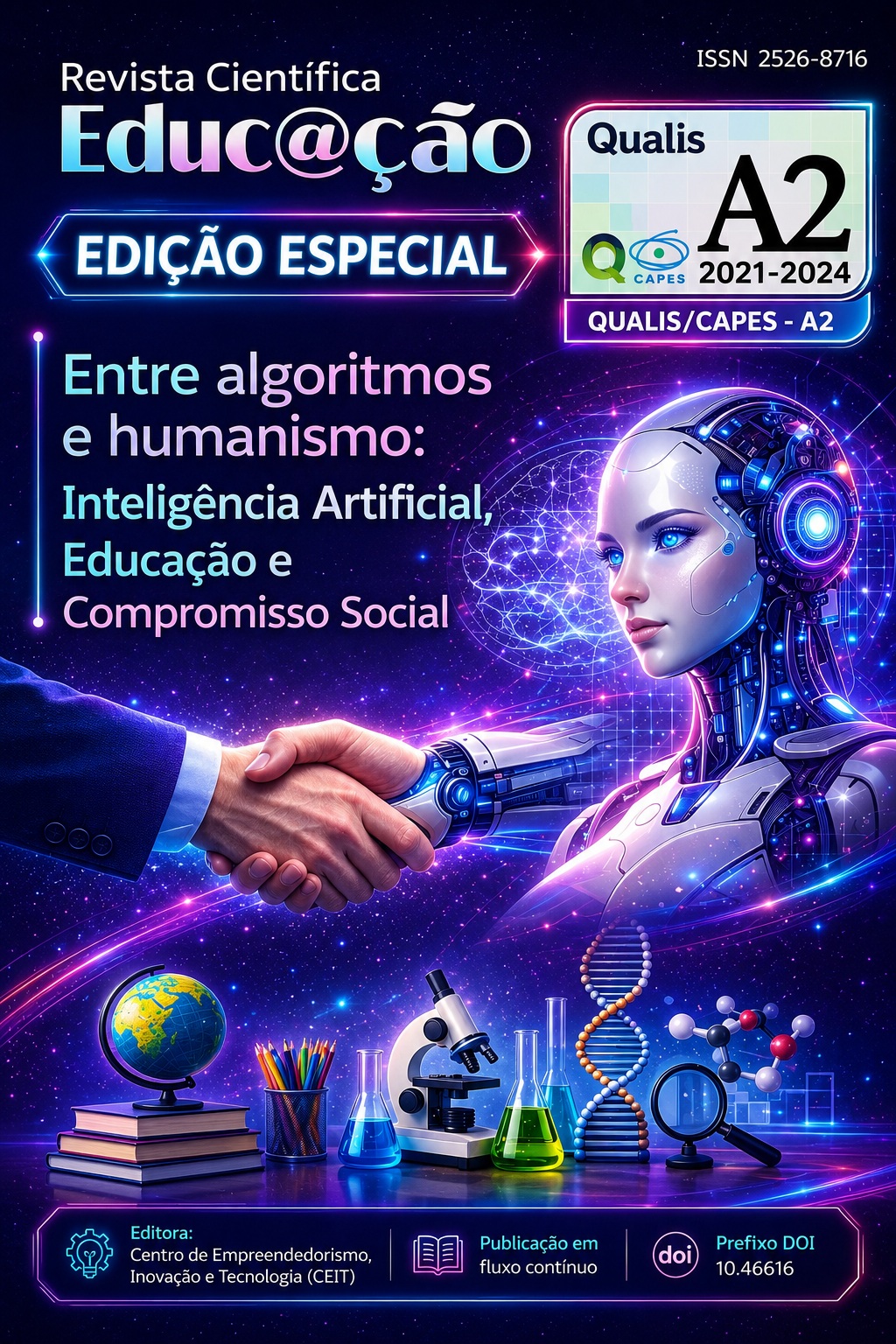
Between algorithms and humanism: a Freirean posthumanist essay on AI and social commitment
DOI:
https://doi.org/10.46616/rce.v12i18.179Keywords:
generative artificial intelligence, critical pedagogy, social commitment, accessibility, teacher educationAbstract
The massive emergence of Generative Artificial Intelligence in Brazilian and Argentinian educational settings reopens, in an unprecedented way, the historical tension between technique and humanization. This theoretical-critical essay, aligned with the dossier Between Algorithms and Humanism, articulates the Freirean tradition of social commitment, contemporary algorithmic critique and posthumanist renewal to address this tension. The aim is to construct an original conceptual framework, named PHARE (Humanizing Pedagogy for Reflective and Emancipatory AI), applicable to teacher education and pedagogical practice in the Ibero-American space. The methodological approach is hermeneutic-critical, organized in three movements: diagnosis of algorithmic rationality, Freirean recovery of the concept of viable unprecedented in dialogue with Susana Copertari, and posthumanist synthesis around the conceptual figure of the deaf-cyborg assemblage, formulated to situate the deaf body as a privileged laboratory of algorithmic ethics. The PHARE framework comprises five guiding principles: algorithmic dialogicity, epistemic transparency, distributed agency, decolonial commitment, and emancipatory horizon with radical accessibility. We conclude that Ibero-American pedagogy of AI requires both the denunciation of the colonial configurations of technique and the invention, in the horizon of the viable unprecedented, of modes of appropriation that honor Latin American education historic commitment to peoples, languages and bodies historically silenced by algorithmic phonocentrism.
Downloads
References
ADAMO-VILLANI, Nicoletta et al. Inclusive deaf education enabled by artificial intelligence: the path to a solution. International Journal of Artificial Intelligence in Education, v. 34, p. 33-65, 2024. DOI: 10.1007/s40593-024-00419-9. DOI: https://doi.org/10.1007/s40593-024-00419-9
ADORNO, Theodor W. O ensaio como forma. In: COHN, Gabriel (org.). Theodor W. Adorno. São Paulo: Ática, 1986. p. 167-187.
ANDERS, Bret et al. Critical education, generative artificial intelligence and the tyranny of freedom: a critique of modern technocracy. Technology, Pedagogy and Education, 2025. DOI: 10.1080/1475939X.2025.2547728. DOI: https://doi.org/10.1080/1475939X.2025.2547728
ANTONESCU, Carmen. Exploring research ethics through the lens of critical posthumanism in the age of artificial intelligence. Teaching in Higher Education, 2025. DOI: 10.1080/13562517.2025.2465995. DOI: https://doi.org/10.1080/13562517.2025.2465995
AOUNI, Hanen et al. Beyond technical skills: a pedagogical perspective on fostering critical engagement with generative AI in university classrooms. Frontiers in Education, v. 10, art. 1593278, 2025. DOI: 10.3389/feduc.2025.1593278. DOI: https://doi.org/10.3389/feduc.2025.1593278
ATABEKOVA, Anastasia et al. Algorithmic dependence and digital colonialism: a conceptual framework for artificial intelligence in education and knowledge systems of the Global South. Frontiers in Education, v. 11, art. 1720563, 2026. DOI: 10.3389/feduc.2026.1720563. DOI: https://doi.org/10.3389/feduc.2026.1720563
AUTOR. Referência anonimizada para o processo de avaliação às cegas. 2025.
AUTOR. Referência anonimizada para o processo de avaliação às cegas. 2026.
BAUMAN, H-Dirksen L. Listening to phonocentrism with deaf eyes: Derrida mute philosophy of (sign) language. Essays in Philosophy, v. 9, n. 1, art. 2, 2008. DOI: 10.5840/eip2008912. DOI: https://doi.org/10.5840/eip20089118
BENDER, Emily M.; GEBRU, Timnit; McMILLAN-MAJOR, Angelina; SHMITCHELL, Shmargaret. On the dangers of stochastic parrots: can language models be too big? In: Proceedings of the 2021 ACM Conference on Fairness, Accountability, and Transparency. New York: ACM, 2021. p. 610-623. DOI: 10.1145/3442188.3445922. DOI: https://doi.org/10.1145/3442188.3445922
BRAIDOTTI, Rosi. Posthuman ethics for AI. Journal of Bioethical Inquiry, 2025. DOI: 10.1007/s11673-025-10447-2. DOI: https://doi.org/10.1007/s11673-025-10447-2
BUTLER-REES, Aimée. Humanism strikes back? A posthumanist reckoning with self-development and generative AI. AI & Society, 2025. DOI: 10.1007/s00146-025-02339-1. DOI: https://doi.org/10.1007/s00146-025-02339-1
BUZATO, Marcelo El Khouri. Inteligência artificial, pós-humanismo e educação: entre o simulacro e a assemblagem. Dialogia, n. 44, e23906, 2023. DOI: 10.5585/44.2023.23906. DOI: https://doi.org/10.5585/44.2023.23906
CANDAU, Vera Maria. Direitos humanos, educação e interculturalidade. Revista Brasileira de Educação, v. 13, n. 37, p. 45-56, 2008. DOI: 10.1590/S1413-24782008000100005. DOI: https://doi.org/10.1590/S1413-24782008000100005
CARNEIRO, Mara Lúcia Fernandes et al. Por uma revisão crítica do uso de inteligência artificial na educação. SciELO Preprints, 2025. DOI: 10.1590/SciELOPreprints.11450. DOI: https://doi.org/10.1590/SciELOPreprints.11450
CELLARD, André. A análise documental. In: POUPART, Jean et al. A pesquisa qualitativa. Petrópolis: Vozes, 2012. p. 295-316.
COPERTARI, Susana; SGRECCIA, Natalia. Postgrados a distancia y virtualización en la Universidad Nacional de Rosario. Educación y Humanismo, v. 13, n. 20, p. 14-32, 2011.
COPERTARI, Susana; SGRECCIA, Natalia; FANTASÍA, Yanina. Educación a distancia y formación docente. Revista de la Escuela de Ciencias de la Educación, v. 1, n. 9, p. 11-31, 2014.
COULDRY, Nick; MEJIAS, Ulises A. Data colonialism: rethinking big data relation to the contemporary subject. Television & New Media, v. 20, n. 4, p. 336-349, 2019. DOI: 10.1177/1527476418796632. DOI: https://doi.org/10.1177/1527476418796632
CRAWFORD, Kate. Atlas of AI. New Haven: Yale University Press, 2021.
D'IGNAZIO, Catherine; KLEIN, Lauren F. Data feminism. Cambridge, MA: MIT Press, 2020.
EUBANKS, Virginia. Automating inequality. New York: St. Martin's Press, 2018. DOI: https://doi.org/10.1038/scientificamerican1118-68
FREIRE, Paulo. Pedagogia do oprimido. 17. ed. Rio de Janeiro: Paz e Terra, 1987 [1968].
FREIRE, Paulo. Pedagogia da autonomia. São Paulo: Paz e Terra, 1996.
FREIRE, Paulo. Pedagogia da indignação. São Paulo: Editora UNESP, 2000.
GIROUX, Henry A. On critical pedagogy. London: Continuum, 2011.
HARAWAY, Donna J. A cyborg manifesto. In: HARAWAY, D. Simians, cyborgs, and women. New York: Routledge, 1991. p. 149-181.
HARAWAY, Donna J. Staying with the trouble. Durham: Duke University Press, 2016. DOI: https://doi.org/10.2307/j.ctv11cw25q
HUI, Yuk. The question concerning technology in China. Falmouth: Urbanomic, 2016.
HUI, Yuk. Machine and sovereignty. Minneapolis: University of Minnesota Press, 2024.
JANDRIĆ, Petar et al. Critical GenAI literacy: postdigital configurations. Postdigital Science and Education, 2025. DOI: 10.1007/s42438-025-00573-w. DOI: https://doi.org/10.52612/journals/eol-oe.2025.e2423
LARROSA, Jorge. Notas sobre a experiência e o saber de experiência. Revista Brasileira de Educação, n. 19, p. 20-28, 2002. DOI: 10.1590/S1413-24782002000100003. DOI: https://doi.org/10.1590/S1413-24782002000100003
NOBLE, Safiya Umoja. Algorithms of oppression. New York: NYU Press, 2018.
O'NEIL, Cathy. Weapons of math destruction. New York: Crown, 2016.
SANTOS, Boaventura de Sousa. The end of the cognitive empire. Durham: Duke University Press, 2018.
SELWYN, Neil. The future of AI and education: some cautionary notes. European Journal of Education, v. 57, n. 4, p. 620-631, 2022. DOI: 10.1111/ejed.12532. DOI: https://doi.org/10.1111/ejed.12532
SELWYN, Neil. On the limits of artificial intelligence (AI) in education. Nordisk Tidsskrift for Pedagogikk og Kritikk, v. 10, n. 1, p. 3-14, 2024. DOI: 10.23865/ntpk.v9.6062. DOI: https://doi.org/10.23865/ntpk.v10.6062
SKLIAR, Carlos (org.). A surdez: um olhar sobre as diferenças. Porto Alegre: Mediação, 1998.
STIEGLER, Bernard. Technics and time, 1. Stanford: Stanford University Press, 1998. DOI: https://doi.org/10.1515/9781503616738
SUOPAJÄRVI, Tiina et al. Generative artificial intelligence in education: (what) are we thinking? Learning, Media and Technology, 2025. DOI: 10.1080/17439884.2025.2518258. DOI: https://doi.org/10.1080/17439884.2025.2518258
WEGERIF, Rupert. A dialogic theoretical foundation for integrating generative AI into pedagogical design. British Journal of Educational Technology, v. 57, n. 1, 2026. DOI: 10.1111/bjet.70026. DOI: https://doi.org/10.1111/bjet.70026
Published
How to Cite
Issue
Section
License
Copyright (c) 2026 Os Direitos Autorais para artigos publicados nesta revista são do/a autor/a, resguardando-se os direitos de primeira publicação para a Revista RCE. Sendo esta Revista de acesso público, todos os artigos são de uso gratuito, com atribuições próprias, em aplicações educacionais e não-comerciais, desde que citada a fonte, quando utilizados os artigos em parte ou no todo.

This work is licensed under a Creative Commons Attribution-ShareAlike 4.0 International License.